Combustible dusts, according to OSHA, are any combustible solid material composed to distinct particles or pieces, regardless of shape, size or chemical composition that presents a fire or deflagration (exposion) hazard when suspended in air. The National Fire Protection Assoc (NFPA) states that any material that will burn in air as a solid can be explosive in a finely-divided form, and any industrial process that reduces materials into small particles presents a potential for a serious fire or explosion. Facilities that manufacture powders, as well as, those that incidentally generate them through the handling and processing of solid materials are subject to the combustible dust hazard. These materials such as, various metals, wood, plastic, rubber, coal, flour, sugar, and paper. Below are several links that discuss the potential hazards, and prevention of dust explosions.
Sustainable Plant magazine’s June 2012 edition features an in-depth article about the danger of combustible dust.
Get started with Dodge for your variable speed drive application needs using the drives for industry and application guide. Click here for a link to the information for all the drive solutions for your industry. For inquiries regarding drive specification, troubleshooting, or related topics, contact Binkelman’s Kevin Grady at kevin.grady@binkelman.local or 419.537.9333.
The new all-compatible drives portfolio
Aside from all the proper adjustments and operating parameters required to gain the most in screening efficiency, the need for good preventive maintenance practices is a must for longer lasting screens and reliable performance. “Above all, be proactive,” says Deister Machine Co. Service Manager Scott Murphy, an industry veteran with more than 25 years of experience. “Develop a keen focus in forecasting, and then fixing, each factor that could cause potential problems. And take the time to do maintenance the right way — before, rather than after, component failures occur.” Murphy shares the following tips for superior screen maintenance.
Establish an oil sampling program.
Employ recommended lubrication practices.
Maintain proper belt tension.
Prevent material buildup.
Maintain proper screen media support and tensioning.
Binkelman has decades of aggregate industry experience under our “belt”. Call us at 800.863.4673 or click here to contact us for your the MRO needs in your facility.
A big step toward success is choosing the proper lubricant from one of two basic types: mineral-based or synthetic (with the most common synthetic types being hydrocarbon polyalphaolefins [PAOs] and polyalkylene glycols [PAGs]). That choice should be predicated on a product’s characteristics—i.e., viscosity, viscosity index, pour point and additive package.
Conversely, choosing and/or using the wrong product, wrong viscosity, wrong additives, etc., are steps toward improper lubrication. Likewise, not maintaining the correct oil-fill level, operating the gearbox with dirty or contaminated oil and other poor lube practices also can be the kiss of death for your equipment.
Lubricant function in gear reducers
In all speed reducers or gear drives, friction is created between internal moving components. The primary function of the lubricant is to minimize the friction caused by the sliding and rolling action of the gears and bearings and to dissipate heat by providing a thin layer of oil between moving components. With a typical thickness of just 0.00005 of an inch, this layer of oil, known as elastohydrodynamic (EHD) film, separates the mating surfaces of components, preventing metal-to-metal contact and minimizing wear. If the EHD film is insufficient for the transmitted load, metal-to-metal contact of the mating surfaces occurs and causes pitting of gear teeth. No EHD film—or an insufficient amount of it—can also cause scuffing of the gear teeth and leads to bearing and gear failure.
Pumps have historically been a backbone of many applications, including commercial buildings, municipal water and wastewater management, irrigation and agriculture; and are certainly key contributors in industrial systems found in chemical, oil and gas, and pulp and paper industries. Pumping systems account for nearly 25 percent of the energy consumed by electric motors, and for 20 to 60 percent of the total electrical energy usage in many industrial, water and wastewater treatment facilities. Optimizing these processes presents extensive potential savings opportunities, which far exceed more commonplace activity such as motor maintenance/optimization and fan/compressor system upgrades.
While pumps continue to perform the tasks for which they were designed – movement of liquids/solids – there are several trends impacting the future of pumps and pump systems. Historically, pumps have been supplied as part of larger systems and were frequently misapplied, improperly sized, and generally left to be standalone components in larger systems. Many trends in various industrial markets have increased the visibility of pumping, and ultimately the “pump system” as a key component. Key trends include:
The Toshiba P9 low voltage adjustable speed drive is a revolution in pump control. By incorporating Toshiba’s proprietary, ground-breaking Virtual Linear Pump (VLP) Technology, the P9 directly, precisely, and linearly controls pressure, temperature, or flow. The P9 eliminates many obstacles users thought were an integral part of pump control and sets a new standard in ingenuity, performance, and ease-of-use for the pump industry. The below video gives an overview of the features of the P9.
Hydraulic hoses are literally the life lines of most construction equipment. Nothing can grind productivity to a halt faster than a ruptured hose. A little time invested up front to monitor the condition of the hydraulic hoses and fittings can dramatically reduce expensive failures in the field. “The potential cost of hose failure in terms of lost production, environmental impacts and possible injury to operators and others argues strongly in favor of replacing hoses on a time-based schedule, periodic visual inspection or some combination of the two,” says Douglas Jahnke, marketing manager, Eaton’s Hydraulics Group. “Hose replacement while equipment is already ‘out of service’ as part of a planned preventive maintenance schedule can prevent critical downtime and expense.“As a general rule, hoses should be replaced as part of a preventive maintenance(PM)program, especially in critical applications,” agrees Tim Deans, Gates Global Hydraulic Systems engineer. “Consider that hose shelf life is similar to automobile tires. After four to six years,the rubber begins to break down and you can expect to see visual cracking and weeping around the couplings.”
A critical area of importance on any conveyor system is the splice, and in most aggregate operations, there are two preferred types of splicing methods: mechanical splicing, the process of joining belt ends by metal hinges or plates, and vulcanized splicing, the process of joining belt ends through heat and/or chemicals. Understanding the pros and cons of each splicing method is extremely important when making an educated decision on which splicing method to use.
Choosing a hose assembly that is safe and cost-effective for your application may seem intimidating. STAMPED is an acronym that the hose industry standardized on to include all the aspects of the hose selection process.
S.T.A.M.P.E.D.
S Size
T Temperature
A Application
M Material being conveyed
P Pressure
E Ends
D Delivery
Click here to learn more about Binkelman’s full industrial hose assembly capabilities.
When making a drive conversion or designing a new power transmission system, maintenance managers and design engineers have three broad options: roller chain drives, V-belt drives and synchronous belt drives.
Each has its own advantages and disadvantages, along with cost considerations that may not be immediately apparent.
One of the most important tasks in implementing a motor-management program is making the business case for the investment. But motor management involves preventive and predictive maintenance, activities top management historically has been hesitant to support. Top management’s skepticism will be particularly tough when it comes to spending money to test operational motors that show no visual or audible clues of problems. Managers do not help their case when they underestimate the impact and cost of failure, both on maintenance and operations.
The key to success in selling the program is showing the impact a motor failure can have on facility operations related to a critical application. If a motor supporting such an application has failed recently, use it as the example. Managers must demonstrate the differences between a planned and an emergency repair. Underestimating any of these elements only makes the task of selling the program more difficult.



 Aside from all the proper adjustments and operating parameters required to gain the most in screening efficiency, the need for good preventive maintenance practices is a must for longer lasting screens and reliable performance. “Above all, be proactive,” says Deister Machine Co. Service Manager Scott Murphy, an industry veteran with more than 25 years of experience. “Develop a keen focus in forecasting, and then fixing, each factor that could cause potential problems. And take the time to do maintenance the right way — before, rather than after, component failures occur.” Murphy shares the following tips for superior screen maintenance.
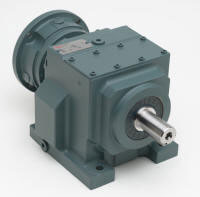 A big step toward success is choosing the proper lubricant from one of two basic types: mineral-based or synthetic (with the most common synthetic types being hydrocarbon polyalphaolefins [PAOs] and polyalkylene glycols [PAGs]). That choice should be predicated on a product’s characteristics—i.e., viscosity, viscosity index, pour point and additive package.
 Pumps have historically been a backbone of many applications, including commercial buildings, municipal water and wastewater management, irrigation and agriculture; and are certainly key contributors in industrial systems found in chemical, oil and gas, and pulp and paper industries. Pumping systems account for nearly 25 percent of the energy consumed by electric motors, and for 20 to 60 percent of the total electrical energy usage in many industrial, water and wastewater treatment facilities. Optimizing these processes presents extensive potential savings opportunities, which far exceed more commonplace activity such as motor maintenance/optimization and fan/compressor system upgrades.
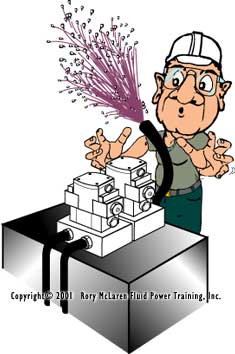 Hydraulic hoses are literally the life lines of most construction equipment. Nothing can grind productivity to a halt faster than a ruptured hose. A little time invested up front to monitor the condition of the hydraulic hoses and fittings can dramatically reduce expensive failures in the field. “The potential cost of hose failure in terms of lost production, environmental impacts and possible injury to operators and others argues strongly in favor of replacing hoses on a time-based schedule, periodic visual inspection or some combination of the two,” says Douglas Jahnke, marketing manager, Eaton’s Hydraulics Group. “Hose replacement while equipment is already ‘out of service’ as part of a planned preventive maintenance schedule can prevent critical downtime and expense.“As a general rule, hoses should be replaced as part of a preventive maintenance(PM)program, especially in critical applications,” agrees Tim Deans, Gates Global Hydraulic Systems engineer. “Consider that hose shelf life is similar to automobile tires. After four to six years,the rubber begins to break down and you can expect to see visual cracking and weeping around the couplings.”